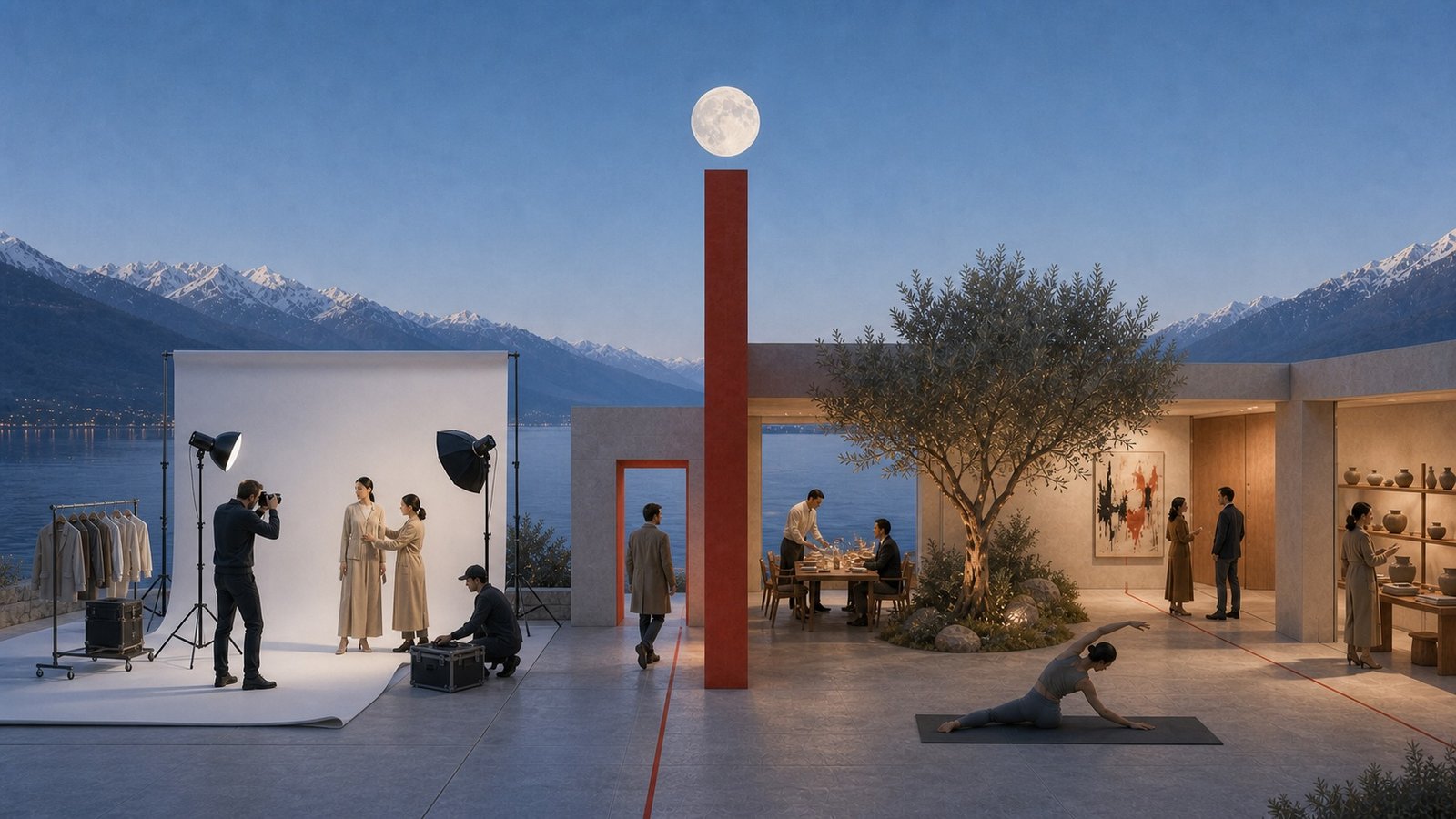
Luxury brands seem increasingly reluctant to remain brands in the traditional sense. They are becoming restaurants, beach clubs, hotels, wellness destinations, cultural programmers, art patrons and temporary landlords of some of the most desirable locations in Europe.
This summer alone, Louis Vuitton returned to Saint-Tropez with its restaurant led by Arnaud Donckele and Maxime Frédéric. Gucci took over La Rose des Vents in Monaco, covering the beach club in its Flora codes. Burberry transformed the Hôtel Belles Rives in Antibes with its blue check and branded experiences for guests. Loewe continued to multiply seasonal stores and pop-ups, while Dioriviera expanded to numerous locations around the world. Vogue has documented how these seasonal brand environments are now becoming an increasingly established part of the European luxury calendar. (vogue.com)
Alo offers an even more explicit example of this shift. During its European expansion, the company turned a 72-metre yacht into a floating expression of the brand, hosting Pilates sessions, wellness treatments, creators and product experiences. Benedetta Petruzzo, Alo’s international CEO, has described the company’s ambition as the construction of a “global cultural ecosystem”, extending from retail into wellness centres, community, experiences, beauty and accessories. The company has even begun using the term “Alosphere” to describe that increasingly broad environment. (vogue.com)
Taken individually, these initiatives can look like elaborate activations. Taken together, they reveal something more structural. Brands no longer want simply to communicate a message. They increasingly want to create environments in which people can spend time, eat, travel, exercise, socialise, discover artists, collect objects and participate in experiences. The shift is from communicating a brand to inhabiting one.
In other words, brand campaigns are increasingly giving way to brand worlds.
The strategic logic is easy to understand. Campaigns are temporary. They appear, generate attention and disappear when the next season arrives. A brand world has the potential to be more durable because it can connect product, place, people, service, hospitality, culture and content inside a broader system. It allows the consumer to experience what a brand represents rather than simply being told through advertising.
This is particularly attractive in luxury, where brands are under increasing pressure to justify high prices and maintain distinctiveness in categories where visual codes travel quickly. A product can be copied aesthetically. A store concept can be replicated. A campaign can be imitated within months. A broader ecosystem is harder to reproduce because it depends on the combination of many decisions over time.
But the enthusiasm for world-building creates another problem.
Not every brand building a world has a strong enough point of view to make that world meaningful.
From campaign to environment
The expansion of luxury into hospitality illustrates the opportunity clearly. When Louis Vuitton operates a restaurant in Saint-Tropez, it enters a moment of the customer’s life that previously belonged to another category. When Gucci takes over a beach club in Monaco, the brand moves from dressing the consumer to shaping the environment around them. When Burberry brings its visual codes into a hotel on the Côte d’Azur, it turns a recognizable pattern into an atmosphere, a place and a memory. (vogue.com)
The brand is no longer only something people wear or purchase. It becomes something they can inhabit.
From a commercial perspective, the attraction is obvious. A customer may only buy a handbag or jacket occasionally, but a brand can potentially interact with that same customer through food, travel, wellness, entertainment and cultural experiences much more frequently. The brand world becomes a platform for growth, giving the company permission to enter adjacent categories while reinforcing emotional connection.
Yet more touchpoints do not automatically create more meaning. A branded café, a beach takeover and a cultural partnership can all be successful individually while remaining disconnected from one another. Expansion alone creates activity. It does not necessarily create coherence.
The difference between a collection of activations and a genuine brand world lies in whether those experiences express a shared idea of how people should live, what they should value and what the brand believes belongs in its universe.
Alo is building an ecosystem, not merely advertising
Alo is one of the clearest current examples because the company itself describes the ambition in systemic terms. Its 2026 push has included Cannes, Monaco, Saint-Tropez and Bodrum, alongside retail, wellness programming, influencer experiences and the Alo Voyage yacht. The yacht was used for Pilates sessions, treatments, community programming and creator content, with guests including high-profile influencers and celebrities. (vogue.com)
Seen as a series of isolated marketing stunts, it would be easy to dismiss this as a sophisticated extension of influencer marketing. But the scale and consistency of the initiative suggest something more ambitious. Alo increasingly positions itself not simply as an activewear company but as a broader interpretation of wellness, mobility, aspiration and contemporary lifestyle. Its retail stores, events, wellness experiences and future beauty ambitions all sit inside the same direction.
The interesting point is not that Alo wants to sell more categories. Most successful brands eventually do. The interesting point is that it is attempting to create a context in which those categories feel naturally connected. The “Alosphere” only works if consumers understand why a beauty product, a yoga class, a yacht, an accessory and a pair of leggings all belong to the same universe.
That coherence cannot ultimately come from the logo. It has to come from a shared belief about the kind of life the brand represents. If that belief weakens, the world begins to look less like an ecosystem and more like a collection of commercial extensions.
JW Anderson shows another way to build a world
Jonathan Anderson offers an almost opposite model. His world is not built primarily through scale or lifestyle expansion, but through personal curation and taste.
JW Anderson has moved away from conventional runway-led growth and increasingly centred the brand around its stores and the objects inside them. Fashion sits alongside furniture, art, craft, restored garden tools, blankets, ceramics, candles and objects sourced or commissioned across Britain. Anderson has described this approach very simply: “this is how I live. This is my world, what I collect”. In 2026, he even said that he increasingly feels like a store owner rather than a brand owner. (vogue.com)
The coherence here does not come from product category. A blanket, a bronze object, a piece of knitwear and an old gardening tool do not obviously belong together in a conventional merchandising system. They become coherent because they reveal a recognizable taste.
That distinction matters. A credible brand world allows unexpected things to belong because the point of view connecting them is strong enough. The consumer may encounter an object that has little obvious relationship to the core product and still think: of course they chose this.
That reaction is one of the clearest signs that a brand has developed something deeper than an assortment.
Loewe demonstrates what happens when culture becomes structural
Loewe provides another useful example because its cultural expansion has been built over time rather than through a sequence of short-term activations.
Under Jonathan Anderson, craft became one of the house’s central organising ideas. The Loewe Foundation Craft Prize, launched nearly a decade ago, grew into an international competition and exhibition celebrating makers across disciplines. When the prize returned to Madrid in 2025, more than 4,600 works had been submitted and 30 finalists were selected. Over time, the initiative helped create a broader network of artists and artisans connected to the house. (vogue.com)
The important point is that craft was not simply added as a cultural theme. It was connected to Loewe’s actual history as a leather house and then expanded into a broader contemporary idea. The company did not merely associate itself with makers because craft had become fashionable. It used craft to articulate something already present within the brand.
That is why this type of cultural investment can survive changes in creative leadership. Loewe’s new creative directors Jack McCollough and Lazaro Hernandez have continued to identify Spanish identity and craft as important pillars of the house. (vogue.com)
This is an important distinction. Cultural strategy becomes powerful when it is structural enough to outlive an individual campaign or creative director. It becomes part of the logic of the brand rather than part of the communication calendar.
Art is becoming a compulsory language of luxury
The same movement can be seen in the relationship between luxury and the art world. Fashion houses have always had strong links with artists, photographers, architects and designers, but the intensity of those relationships is growing.
Vogue recently highlighted how Gucci, Dior and Louis Vuitton all leaned deeply into art for their resort presentations. Louis Vuitton staged its resort show at the Frick Collection in New York as part of a three-year cultural sponsorship that includes exhibition support and public-access initiatives. Gucci referenced Robert Longo’s Men in the Cities for its Times Square presentation, while Dior presented work at LACMA and drew on a network of artistic references including Ed Ruscha. (vogue.com)
On one level, this is a natural evolution. Luxury has always existed at the intersection of fashion, art, architecture, cinema and design. These disciplines share audiences, institutions and systems of cultural value.
But as more brands use the same cultural tools, a new risk appears. When every house commissions artists, sponsors exhibitions, hosts cultural dinners and stages events in museums, cultural participation itself starts becoming another category code.
The fact that a brand collaborates with an artist no longer tells us very much. What matters is why that particular artist belongs to that particular brand, what the relationship expresses and whether the collaboration reveals something specific about the brand’s point of view.
The danger of cultural wallpaper
This is where the current enthusiasm for culture becomes strategically interesting.
Is luxury genuinely becoming more cultural, or is culture sometimes being used to compensate for weaker brand meaning?
The two situations can look remarkably similar from the outside. Both may involve prestigious institutions, important artists, beautiful photography, impressive locations and influential guests. Both can generate press and social attention.
Yet the underlying logic is different.
A brand with a strong cultural point of view uses artists, chefs, architects or musicians to express something it already believes. A brand without one can use those same people in the hope that their cultural credibility will transfer onto the company.
One creates meaning. The other borrows it.
This is the danger of cultural wallpaper. Art, architecture, food and hospitality can become premium decorative layers applied to a brand without changing what the brand actually stands for.
An artist collaboration does not automatically create cultural relevance. A restaurant does not automatically create a lifestyle. A foundation does not automatically create intellectual depth. A beach club does not automatically create community. These initiatives only become meaningful when they are manifestations of something more specific.
A brand world without a strong point of view is ultimately just a collection of expensive experiences.
The summer pop-up boom makes the problem visible
The European summer season provides an almost perfect demonstration of this tension. Brands are spreading across Saint-Tropez, Capri, Ibiza, Monaco, Mykonos and other luxury destinations through branded hotels, beach clubs, cafés, restaurants and seasonal stores.
Vogue has documented Loewe opening multiple seasonal locations, Dioriviera operating across numerous destinations, Armani touring its Mare concept around European resorts, Gucci taking over a Monaco beach club and Burberry transforming the Hôtel Belles Rives. (vogue.com)
The Financial Times has described the same pattern, including Dolce & Gabbana at the Four Seasons San Domenico Palace, Dior at Il Riccio in Capri and Jacquemus at the Mandarin Oriental on the Turkish Riviera. (ft.com)
From a media and customer-acquisition perspective, this makes perfect sense. Luxury consumers travel, and brands follow them into the places where they spend time.
But the success of the playbook is also what makes it vulnerable.
When every brand arrives with parasols, restaurants, loungers, cocktails, monograms and carefully curated summer experiences, a tactic designed to create distinctiveness begins to create similarity. Hospitality, art, wellness, food, travel and private access are becoming common ingredients in contemporary luxury world-building. The ingredients themselves are not the problem. The question is whether each brand combines them in a way that could only belong to that brand.
Without that level of specificity, world-building risks becoming another formula.
Culture cannot replace brand meaning
Culture can deepen a brand enormously. It can connect a company to ideas larger than its products, create permission to enter new categories and generate communities or institutions with long-term value.
But culture cannot manufacture meaning for a brand that does not know what it believes.
If anything, the more cultural extensions a company creates, the more visible the absence of an underlying idea can become. Ten disconnected activations do not necessarily create more coherence than one powerful conviction.
This is why initiatives such as Fondazione Prada, Loewe’s investment in craft or JW Anderson’s highly personal retail universe feel different from many short-term brand takeovers. They do not simply provide places for logos to appear. They reveal something about what those brands consider interesting, valuable or worth supporting.
The standard should therefore be higher than asking whether an initiative looks impressive or generates attention. The more useful question is whether it could credibly have been created by another brand.
If the answer is yes, the execution may still be good, but the strategic distinctiveness is weaker.
A campaign expresses a message. A world expresses a belief system.
Traditional brand strategy often begins with communication questions. What should people know? What should we say? How should we position the product?
Those questions remain important, but world-building requires an additional layer of thinking.
A brand needs to understand what it finds beautiful, what it considers important, which cultural disciplines naturally belong to it, what kind of people fit within its orbit and what kinds of experiences it wants to create. It also needs to define what it rejects and what it would refuse to do even if competitors were doing it successfully.
Without those answers, world-building easily becomes reactive. The brand opens a café because cafés are popular, works with an artist because competitors do, or enters a destination because wealthy consumers are there.
The activation comes first and the reason follows.
Over time, the world gets larger while the centre becomes less defined.
The next competitive advantage is not a bigger world
The movement into hospitality, culture, wellness, art and entertainment is unlikely to reverse. The economics are attractive, the consumer demand exists and brands increasingly need more ways to remain relevant beyond the purchase of a product.
The more interesting question is what happens once nearly everyone adopts the same model.
At that point, another café will not be enough. Another beach club will not be enough. Another artist dinner will not be enough.
The advantage will belong to brands whose worlds feel coherent before the logo becomes visible.
Alo’s challenge will be to ensure that the expanding “Alosphere” continues to express a distinctive idea of wellness as the business moves into more categories and markets. JW Anderson’s challenge will be to turn an intensely personal point of view into a sustainable commercial system without losing the eccentricity that gives it value. Loewe’s challenge will be to prove that the cultural architecture built around craft can outlive the creative era that established it.
The broader luxury sector faces the same question. Are brands participating in culture because they have something meaningful to contribute, or because culture has become the latest language through which premium status is communicated?
There is a meaningful difference between having cultural activities and having cultural meaning.
Brand worlds are replacing brand campaigns, and that may be one of the most important shifts in contemporary brand building. But the brands that win will not necessarily