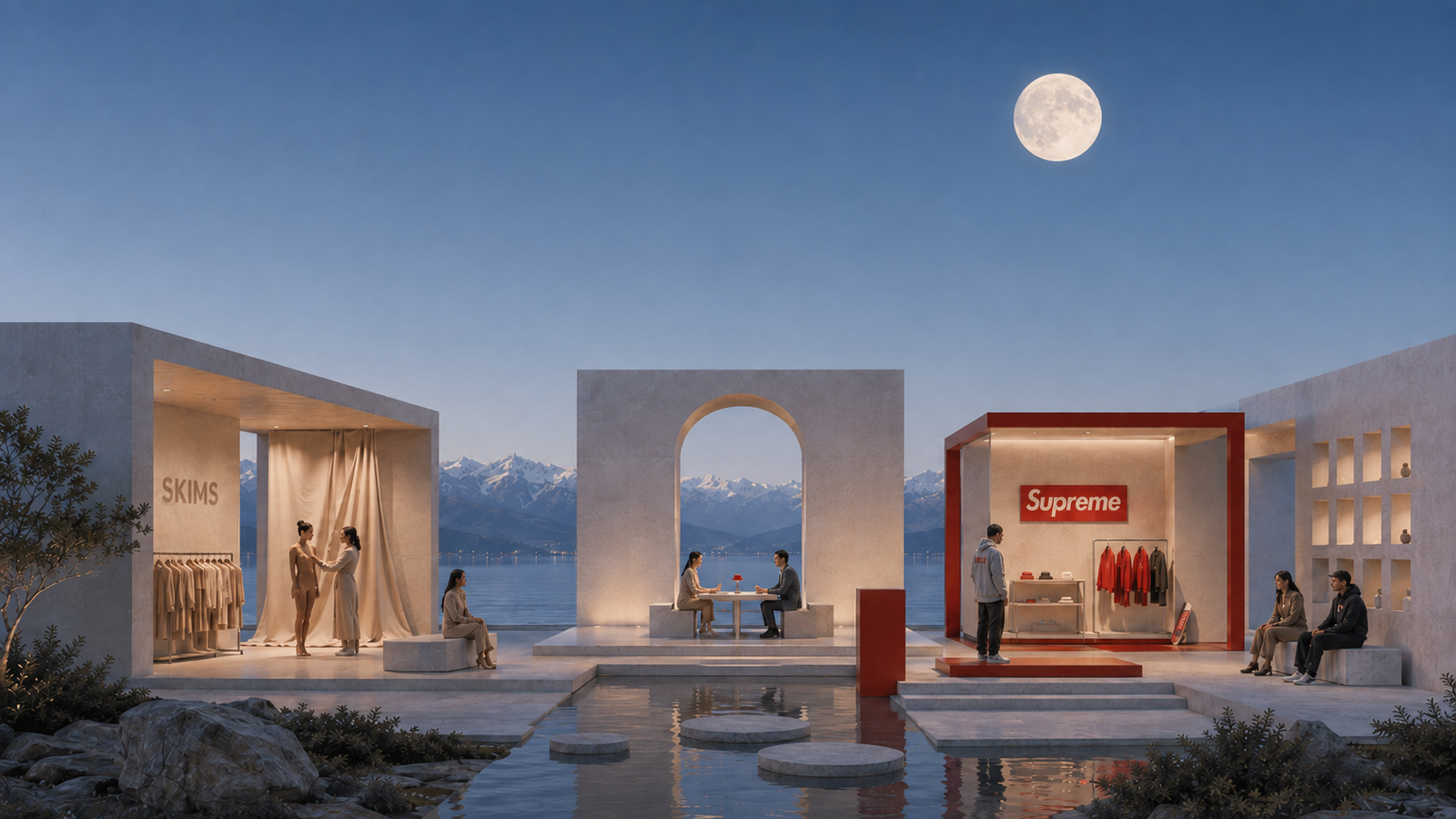
On August 24, SKIMS announced two new senior appointments. Kim Schraub, who has been part of the company since before its 2019 launch, was promoted from Creative Director to the newly created role of Chief Brand Officer. At the same time, SKIMS appointed Erin Magee as its first Chief Design Officer. Magee arrives after more than two decades at Supreme, where she most recently served as Chief Creative Officer, overseeing creative vision, design, product development and product strategy across apparel, accessories, collaborations and special projects.
On paper, this is a fashion executive move. SKIMS is expanding rapidly across categories and markets, so strengthening its design organisation makes obvious business sense. The company was valued at $5 billion after a $225 million funding round in November 2025, has expanded NikeSKIMS internationally, recently opened its first standalone UK flagship on Regent Street, and is entering India through Reliance Brands, alongside further Asian expansion.
But Jens Grede's explanation of the appointment makes the underlying ambition more interesting. The SKIMS CEO did not simply praise Magee as a good designer. He described her as someone with a proven ability to build brands that “transcend fashion and become cultural touchstones.” Kim Kardashian highlighted something similar, pointing to Magee's ability to maintain a strong point of view while remaining connected to her audience.
That language matters. SKIMS is not only recruiting design expertise. It is recruiting someone who spent 22 years inside one of the most successful cultural brand-building systems of the past three decades.
What Supreme actually built
Supreme started in 1994 as a small New York skate shop. It eventually became valuable enough for VF Corporation to acquire it for $2.1 billion in 2020, but its influence cannot be explained by scale alone. At the time of the acquisition, VF executives described Supreme as being anchored in “cultural legitimacy”, a useful phrase because that legitimacy had been accumulated through hundreds of decisions that conventional fashion marketing would often have considered irrational.
Supreme collaborated with artists, musicians, fashion houses and companies that did not obviously belong in the same commercial universe. Its partners ranged from Louis Vuitton and Comme des Garçons to Fender, Everlast and Pat McGrath. Its stores remained connected to skate culture even as the brand became globally recognised. Products arrived through drops rather than conventional seasonal retail logic, and collaborations were frequently chosen because they were unexpected rather than because a market analysis suggested obvious category compatibility.
The famous Louis Vuitton collaboration captures the transformation particularly well. In Supreme's early years, the brand had appropriated luxury iconography with the irreverence of an outsider. By 2017, Louis Vuitton itself was collaborating officially with Supreme. What had once existed at the edges of fashion had become desirable to one of the world's largest luxury houses.
It would be simplistic to attribute that system to one person, and Magee was one member of a much larger organisation. But spending 22 years inside that environment means experiencing a particular way of building brands: one where product, community, timing, collaboration, retail, art, music and cultural judgement are not separate departments added after the strategy. Together, they are the strategy.
That is very different from simply knowing how to design clothes.
SKIMS is reaching the point where product is no longer enough
SKIMS began with a beautifully simple proposition around shapewear and solutions for the body. Seven years later, the company is becoming something much larger. It now operates across underwear, loungewear, menswear and retail, while NikeSKIMS has taken the brand into performance apparel and footwear. The Nike partnership is particularly revealing because it was structured not as a limited collaboration but as a new brand intended for global expansion. Nike described it from the beginning as combining its performance innovation with SKIMS' understanding of fit, form and the female consumer.
This creates a different strategic challenge. It is relatively easy for consumers to understand what a shapewear company should make. It becomes much harder when the same name needs to make sense across underwear, training, footwear, beauty, menswear, stores and potentially further lifestyle categories.
At that stage, product architecture alone cannot hold the company together. SKIMS needs a recognisable way of seeing the world that can travel from one category to another without becoming generic. The brand needs to know not just what it can make, but what feels like SKIMS when it makes it.
The simultaneous creation of a Chief Design Officer and a Chief Brand Officer is therefore significant. Magee will lead design and creative product direction, while Schraub will oversee how SKIMS appears across retail, campaigns, collaborations and storytelling. The organisational structure itself suggests a company formalising the relationship between product and culture as it prepares for a much larger scale.
The challenge is no longer simply growth. It is growing without becoming culturally diluted.
The cultural operator is becoming a leadership role
SKIMS is not alone in looking beyond traditional design credentials when choosing people to shape a brand.
Louis Vuitton's appointment of Pharrell Williams in 2023 was one of the clearest examples. Vuitton did not present Pharrell simply as a fashion designer. Its announcement described creative universes extending across music, art and fashion, and explicitly connected that breadth to Louis Vuitton's ambition to operate as a “Cultural Maison”. His first menswear show then became far more than a runway presentation, bringing fashion, music, celebrity and the city of Paris together on the Pont Neuf for an audience of around 1,750 guests.
The same logic can now be seen outside traditional fashion. Como 1907 appointed Rhude founder Rhuigi Villaseñor as Chief Brand Officer with responsibility extending across fashion, consumer goods, travel and hospitality. The club describes his task as turning Como into more than a football organisation, using the cultural identity of Lake Como as the basis for a global lifestyle brand. Since then, Como has developed fashion collections, partnerships, hospitality projects and other initiatives designed to connect football with the destination's broader cultural appeal.
These appointments are different in title and context, but they share an important characteristic. The person is not being asked merely to manage communication around an existing product. They are being asked to decide which worlds the brand should enter, which references belong to it, which collaborations make sense, how its products should evolve and how commercial expansion can happen without making the brand less interesting.
That requires a different type of creative executive.
A cultural operator sits somewhere between designer, curator, strategist, editor and brand builder. Their value is not simply having good taste. Taste without organisational consequence is decoration. Their value lies in translating a point of view into products, partnerships, places, people and decisions that remain recognisable as the brand expands.
Cultural relevance cannot simply be bought
There is an obvious danger in this model. Once businesses identify cultural relevance as commercially valuable, they naturally try to institutionalise it. Companies create cultural teams, recruit people from admired brands, hire artists, build collaboration departments and commission increasingly sophisticated experiences.
But culture is particularly resistant to being reduced to a corporate capability.
Supreme did not become Supreme because it had a framework called “cultural relevance”. Its significance was built through years of choices about what belonged and what did not. James Jebbia once described the logic behind Supreme's collaborations in remarkably uncomplicated terms: if something had already been done, they generally did not want to do it. The criterion was whether something felt good and whether it could expose young people to a world they did not already know.
That is difficult to reproduce through process because much of its value comes from judgement.
A company can hire someone from Supreme, but it cannot import Supreme's history. SKIMS should not become a streetwear brand, and Magee's appointment would be far less interesting if the objective were to make SKIMS visually resemble her previous employer.
What SKIMS can import is experience in making decisions under cultural rather than purely commercial logic. It can bring inside the organisation someone who understands that a collaboration is not valuable simply because two large names can be placed beside each other, that community is not the same as audience, and that relevance often comes from protecting a strong point of view even when broader commercial opportunities are available.
The real value of a cultural operator is therefore not access to culture. It is knowing what to do with the access a large brand already has.
From creative direction to cultural direction
For a long time, the Creative Director occupied a relatively understandable position inside fashion. Their job was to define an aesthetic vision and translate it into collections, imagery and stores. The strongest creative directors always did more than that, but the organisational model remained largely centred on product and image.
Today's brands increasingly operate across a much wider field. SKIMS can simultaneously be an underwear company, a Nike partner, a physical retailer, a celebrity platform and a participant in sport and popular culture. Louis Vuitton can be a fashion house, restaurant operator, art patron, travel brand and entertainment producer. Como can be a football club while also developing fashion, hospitality and travel.
This changes the nature of creative leadership because the number of possible decisions grows exponentially. The difficult question is no longer how to create enough content or ideas. Large organisations have more than enough capability to do that, and AI will make production even easier. The difficult question is deciding which opportunities should belong to the brand at all.
Should SKIMS enter this category? Should it work with this person? Should it appear in this cultural space? Should a partnership become a campaign, a product, a permanent business or nothing at all? Does an opportunity make the company bigger while making the brand weaker? Does something appeal to the audience while contradicting the direction the company wants to establish?
Those decisions require a strong understanding of both commerce and culture. They also require the confidence to reject opportunities, because a cultural identity is shaped as much by exclusion as by participation.
That may explain why people who have spent their careers navigating different cultural systems are becoming attractive to organisations entering their next stage of growth.
SKIMS does not need to become Supreme
The most interesting interpretation of Magee's appointment is not that streetwear is coming to SKIMS. It is that SKIMS has reached a stage where it needs people capable of turning a fast-growing company into a more durable cultural brand.
Supreme spent decades demonstrating that a relatively narrow core product business could create influence far beyond the size of its stores or collections. SKIMS has almost the opposite challenge. It already has enormous visibility, a globally recognised founder, billions of dollars in value and increasingly broad commercial opportunities.
Its question is what to do with all of that without becoming just another very large apparel company.
The answer will not come from celebrity reach alone. Kim Kardashian already provides that. It will not come purely from distribution. SKIMS is rapidly building it. Nor will it come simply from adding more categories.
The next phase depends on whether SKIMS can create a point of view strong enough to make those categories feel connected, make collaborations feel inevitable rather than opportunistic, and give consumers reasons to remain interested after the novelty of growth has disappeared.
That is why Erin Magee's 22 years at Supreme may matter more than the title on her new business card.
SKIMS hired a Chief Design Officer.
But what it may really be looking for is someone who knows how a product becomes part of culture.
Moon Above Advisory helps brands define the cultural territory, strategic decisions and principles that allow growth without losing what makes the brand distinctive.
Discover Moon Above Advisory at www.moonaboveadvisory.com